




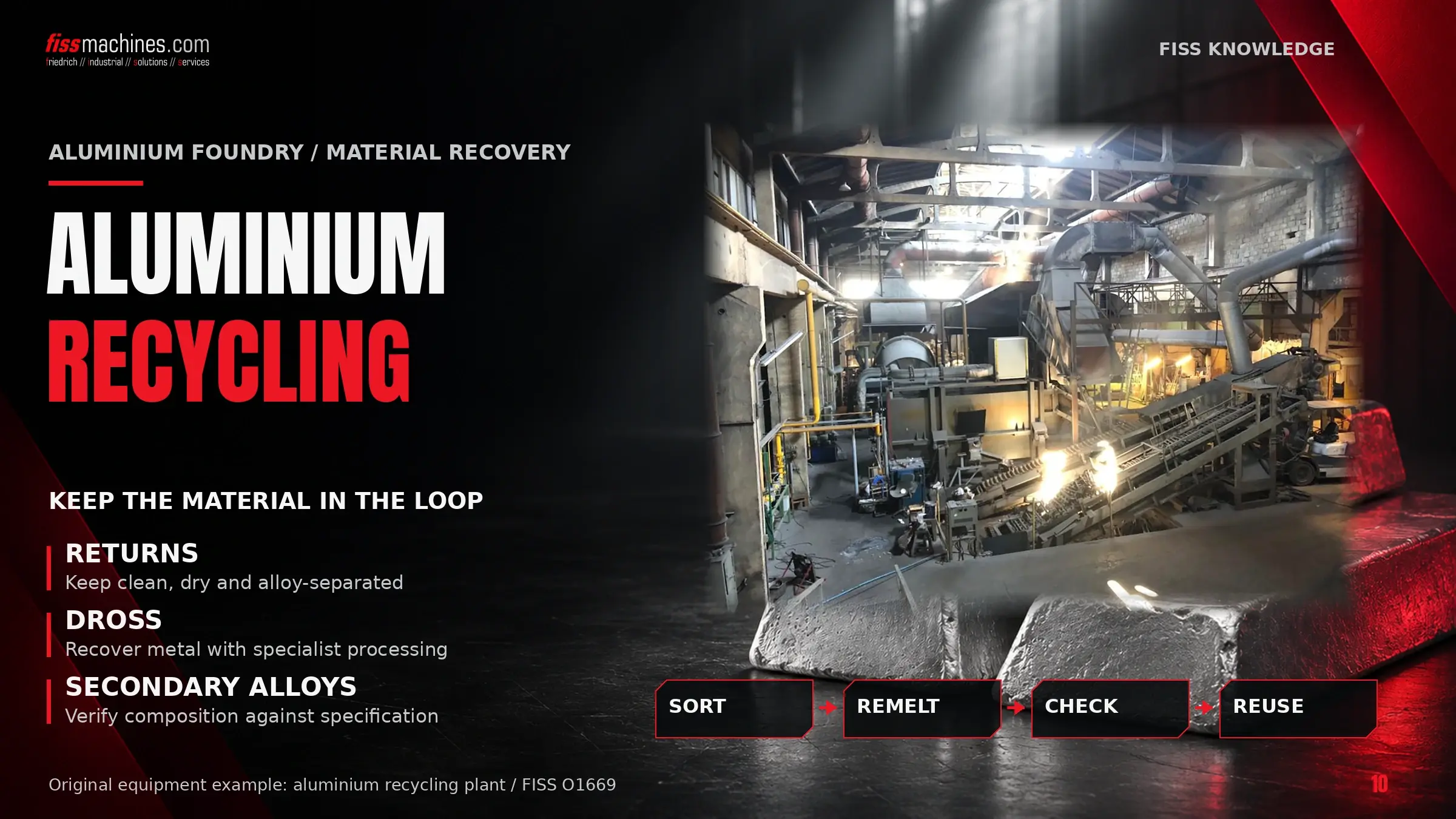
Recycling in the Aluminium Foundry: Returns, Dross and Secondary Alloys
In an aluminium die casting plant, a considerable part of the metal poured never becomes a good part. Runners, overflows, biscuits and rejects go back to the furnace; dross is skimmed off and leaves the plant. How well this loop is managed decides how much metal, energy and alloy quality is retained.
What Does Aluminium Foundry Recycling Cover?
Aluminium foundry recycling covers three material flows: internal returns that are remelted in-house, dross from which the remaining metal is recovered, usually by specialised recyclers, and secondary alloys produced from scrap that the foundry buys as ingots.
The levers are alloy separation, clean and dry returns, low melt loss, careful dross handling and reliable analysis. Energy and CO₂ figures need their source and system boundary.
Four Material Flows in the Melting Shop
Form, surface, moisture and foreign material decide whether a material can go straight back into the melting furnace or needs preparation or a different furnace.
Runners, Overflows, Biscuits
Known alloy, compact pieces. Ideal remelting material if it stays separated by alloy and clean.
Rejected Castings
Same alloy, but possibly with steel inserts, coatings or machining residues.
Machining Residues
Large surface, low bulk density, often wet with cooling lubricant. Need drying or compacting.
Skimmings
Aluminium, oxides and gas. Valuable for its metal content, but not a normal charge.
Every remelted kilogram has consumed melting energy without becoming a good part – why yield is an energy key figure is explained in Energy Efficiency in Die Casting.
Keeping Foundry Returns Clean and Separated
Foundry returns are the most valuable recycling material because their composition is known. That advantage is lost once alloys are mixed: a few bins of a copper-containing alloy can take a low-copper melt out of specification.
- Separate bins per alloy, clearly labelled and colour-coded at every cell
- Remove steel inserts, ejector pins, cast-in bushings and screws before remelting
- Keep returns dry and free of release agent residues, oil and dirt
- Weigh returns and scrap per cell in kilograms, not only in pieces
- Define how much returns may be added to each melt in relation to ingots
Returns are often remelted in shaft melting furnaces, where the charge is preheated in the shaft before melting at its foot. StrikoWestofen states that near-stoichiometric combustion and sealed doors keep oxidation losses low (manufacturer statement). How furnaces are arranged in the metal flow is covered in Dosing Furnace, Melting Furnace or Holding Furnace?
Melt Loss: Where Metal Disappears
Molten aluminium oxidises at its surface; the oxide and trapped metal end up in the dross. Spills and contamination add to the loss. Chips and thin-walled parts, with a large surface relative to their weight, are more exposed than compact returns or ingots.
| Figure | Value | Source and context |
|---|---|---|
| Gross metal yield of refiners and remelters | 70–95 % | IAI/OEA 2009; ingot output compared with scrap input |
| Real metal loss, all scrap melted in the EU-15 | usually below 2 % | IAI/OEA 2009, citing a mass balance by TU Delft (2005) |
| Metal loss for old scrap | 1–5 % | IAI/OEA 2009; depends on scrap type and furnace technology |
| Yield of a shaft melting furnace | up to 99.75 % | Manufacturer statement StrikoWestofen (2020), measurement basis not stated |
Aluminium Dross: Formation, Handling and Recovery
The International Aluminium Institute (IAI) defines dross as a mixture of aluminium, aluminium oxides and gas removed from the melt surface or from furnace, ladle and launder walls. How skimming fits into melt treatment is described in Aluminium Melt Quality: Degassing, Filtration and Oxides.
Skim Carefully
Remove oxides without stirring the bath or taking out more liquid metal than necessary.
Process or Cool Hot Dross
Hot dross keeps oxidising in air. Dross presses squeeze out liquid metal while it is hot; cooling with restricted air access limits further burn-off.
Collect and Document
Keep dross separated by alloy family where possible and record quantities per furnace.
Hand Over to Recyclers
Dross is a traded scrap category: EN 13920-16 covers skimmings, drosses, spills and metallics. Recyclers recover the metal, often in rotary drum furnaces.
Where rotary furnaces melt dross or scrap with fluxing salt, salt slag remains. According to the IAI, the salt protects the melt against oxidation, increases net metal yield and binds inclusions. Salt slag is a residue of its own that is processed further.
Secondary Aluminium Alloys Compared with Primary Alloys
According to the IAI, refiners produce casting alloys from scrap of varying composition and can add alloying elements and remove certain unwanted ones. The IAI states that recycling saves 95 % of the energy needed for primary aluminium: 186 GJ per tonne for global primary production (2019, mine to cast house) against 8.3 GJ per tonne for recycled aluminium.
For greenhouse gases the IAI gives 15.1 t CO₂e per tonne of primary aluminium against 0.52 t for recycling (2022) – noting that the recycling value covers only scrap processing and is not the carbon footprint of recycled aluminium.
| EN 1706 alloy | Fe (castings) | Cu | Typical character |
|---|---|---|---|
| EN AC-42100 (AlSi7Mg0.3) | max. 0.19 % | max. 0.05 % | Low-impurity alloy with tight Fe and Cu limits |
| EN AC-46000 (AlSi9Cu3(Fe)) | max. 1.3 % | 2.0–4.0 % | Die casting alloy with wide tolerances for Fe, Cu and Zn (max. 1.2 %) |
Wide tolerances make alloys such as EN AC-46000 suitable for production from scrap; tight iron limits require primary metal or very clean scrap. More on die casting materials: Aluminium, Zinc or Magnesium?
Iron Accumulation and Spectrometer Analysis
Iron, copper, zinc or manganese are difficult to remove from molten aluminium. Gaustad, Olivetti and Kirchain (2012) name dilution with primary aluminium as the most common countermeasure, which limits how much scrap can be used. In the foundry, steel parts left in returns and contaminated external scrap are typical entry routes for iron.
Spark OES
Optical emission spectrometry offers the highest accuracy and low detection limits – the basis for checking melt samples against the alloy specification.
Handheld XRF or LIBS
Handheld analysers screen and sort incoming material in seconds; Hitachi describes LIBS as particularly good for aluminium alloys and scrap sorting.
Choosing an Aluminium Recycling Furnace
If a foundry wants to process chips, bulky scrap or dross itself, the material decides the furnace. FISS lists used aluminium recycling furnaces and names tilting rotary drum furnaces for bulky, oxide-rich material and dross, chip-melting furnaces for chips, and induction, crucible or tilting furnaces for defined qualities and smaller batches.
- Material: alloy, piece size, oxide content, moisture, oil and coatings
- Throughput per hour or batch and the required metal recovery
- Exhaust capture and treatment matched to the material and local permits
- With rotary furnaces: drum, drive, tilting mechanism, burner, door and lining
Equipment can be part of the loop as well. On its page Sustainable Alternative, FISS argues that used machines extend service life and avoid the emissions of producing new ones, while noting that newer machines can have better energy values.
Closing the Loop Starts at the Casting Cell
Aluminium foundry recycling depends less on one furnace than on discipline: returns separated, clean and weighed; melt loss measured instead of assumed; dross handled quickly and passed to qualified recyclers; compositions verified by analysis. Secondary alloys offer a large energy advantage – within the tolerances the part allows.
Questions About Recycling in the Aluminium Foundry
Are Secondary Aluminium Alloys of Lower Quality?
Not per se. EN AC-46000 is a standardised alloy with its own limits. It is unsuitable where a part needs low iron or copper.
How Much Energy Does Recycled Aluminium Save?
The IAI states 95 % compared with primary aluminium (186 vs 8.3 GJ/t). The figure depends on data year and system boundary.
Can Dross Be Remelted in the Normal Melting Furnace?
Generally not as a normal charge. Its metal is recovered by recyclers or in dedicated equipment such as rotary drum furnaces or dross presses.
Why Should Returns Be Weighed Instead of Counted?
Only weight shows how much metal circulates, how much energy it consumes and how high melt loss really is.
Used Recycling Furnaces from FISS.
FISS lists used aluminium recycling furnaces and melting equipment and helps foundries assess whether a furnace concept fits their material, throughput and site.
Sources
International Aluminium Institute / Organisation of European Aluminium Refiners and Remelters: Global Aluminium Recycling: A Cornerstone of Sustainable Development, 2009 – refiners and remelters, metal yield, definitions of skimmings (dross) and salt slag.
International Aluminium Institute: Aluminium recycling saves 95% of the energy needed for primary aluminium production and … the recycling process saves a similar percentage in greenhouse gas emissions, international-aluminium.org, accessed 5 November 2026.
EN 1706:2020+A1:2021 – Aluminium and aluminium alloys – Castings – Chemical composition and mechanical properties; status as listed by BSI Knowledge, accessed 5 November 2026.
EN 13920 series – Aluminium and aluminium alloys – Scrap; Part 16: skimmings, drosses, spills and metallics.
G. Gaustad, E. Olivetti, R. Kirchain: Improving aluminum recycling: A survey of sorting and impurity removal technologies, Resources, Conservation and Recycling 58 (2012), pp. 79–87.
StrikoWestofen / Foundry-Planet: Maximise aluminium yield and cut casting costs with a focus on furnace efficiency (2020) and Through thick and thin – the melting furnace for structural components (2015) – manufacturer statements.
Hitachi High-Tech (M. Järvikivi): LIBS, XRF or OES – a rough guide to choosing the right technology for your metals analyser, guide, foundry-planet.com, accessed 5 November 2026.
FISS Machines: Aluminium Recycling Furnaces and Sustainable Alternative, fiss-machines.com, accessed 5 November 2026.
