




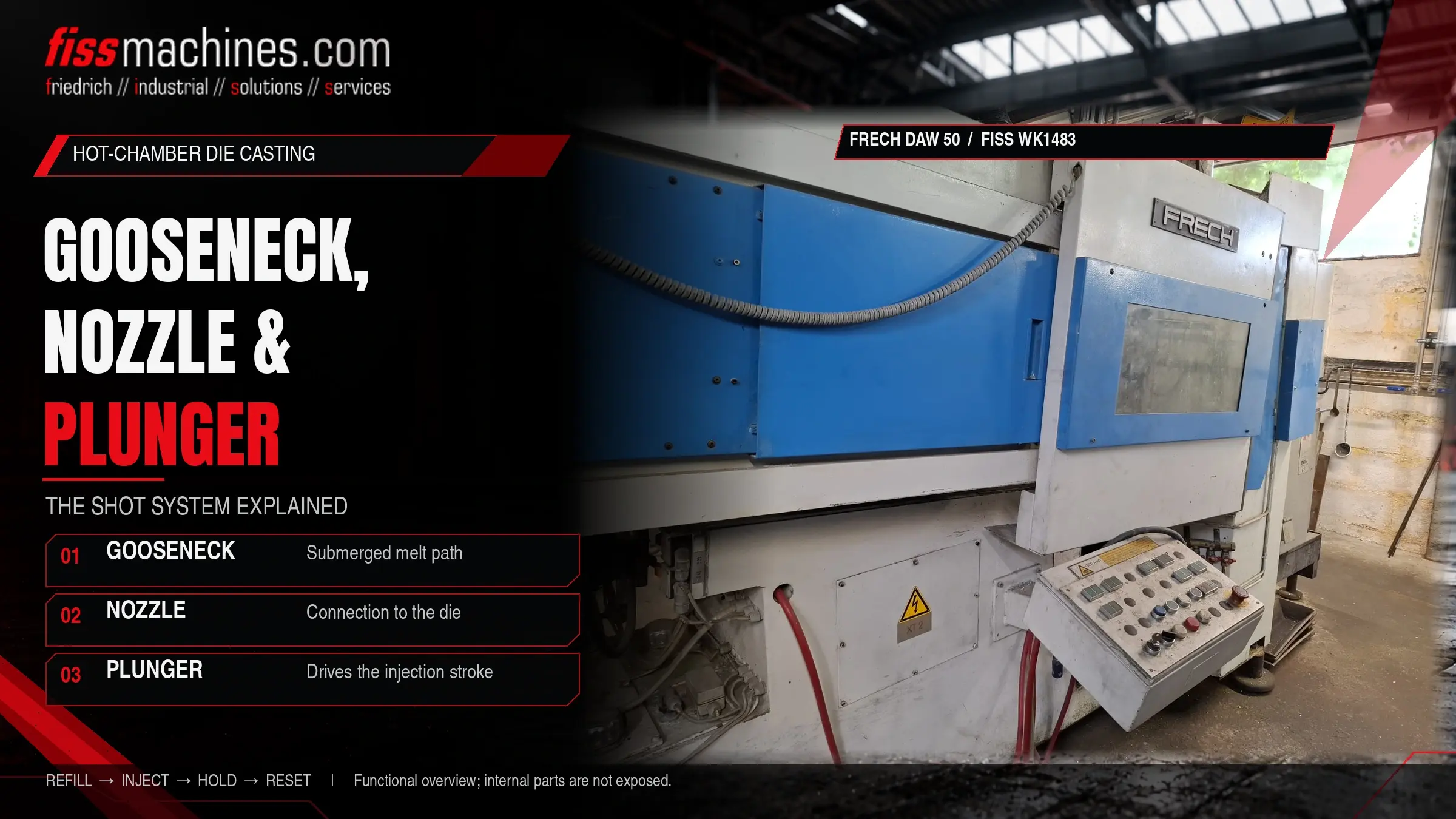
Gooseneck, Nozzle and Plunger: The Shot System of a Hot-Chamber Die Casting Machine
Every shot on a hot-chamber die casting machine depends on three components that sit directly in or next to the molten metal: the gooseneck, the plunger and the nozzle. Together they form the shot system that replaces ladling in zinc and magnesium die casting. Their condition decides whether shot speed, part weight and cycle time remain stable – and they are among the first things to check on a used machine.
What Do Gooseneck, Plunger and Nozzle Do?
The gooseneck is a cast metal body immersed in the melt. It contains the shot cylinder and a curved channel leading up to the die. The plunger moves inside the cylinder: when it retracts, melt flows in through a fill port; when it moves down, it pushes the metal through the channel. The nozzle connects the gooseneck to the sprue bushing of the die and must be kept hot so that the metal does not freeze in it.
Erosion by the melt, sliding wear between plunger and cylinder and thermal load at the nozzle are the main wear mechanisms. Typical consequences are slower fills, fluctuating part weights and metal leaking at the nozzle.
How the Hot-Chamber Shot System Works
In a hot-chamber machine, the shot system is part of the furnace. The gooseneck stands in the metal bath of the holding pot, so the shot cylinder is always filled with liquid metal at the right temperature. A separate metal transfer to the machine, as in cold-chamber die casting, is not required.
Filling
With the plunger retracted, the fill port in the cylinder wall is open and melt flows from the bath into the shot cylinder.
Injection
The plunger moves down, closes the fill port and pushes the metal through the gooseneck channel and the nozzle into the closed die. The shot is typically run in several speed phases.
Intensification and Solidification
The plunger holds pressure while the casting solidifies in the die.
Return
The plunger returns to its start position. Metal that has not solidified flows back through the nozzle and gooseneck, and the cylinder refills for the next shot.
Because filling happens automatically with every plunger return, hot-chamber machines achieve short cycle times. A basic comparison of both machine types is given in the article Cold Chamber or Hot Chamber?.
The Three Parts of the Shot System
Melt Container and Channel
Made of iron-based material. It houses the shot cylinder and the riser channel to the nozzle. Some designs use a replaceable sleeve or liner in the cylinder bore, so the body can be refurbished instead of replaced.
Shot Piston with Rings
Driven by the hydraulic shot cylinder above the bath. Piston rings seal against the cylinder wall. As rings and bore wear, more metal bypasses the plunger and less of the stroke reaches the die.
Heated Connection to the Die
Seats against the sprue bushing of the fixed die half. Depending on the design, it is heated by gas burners or electric heaters, because the metal in it must not freeze between shots.
The parts are matched to each other and to the machine: plunger diameter, cylinder bore, gooseneck geometry and nozzle length determine the available shot volume and the pressure on the metal. Changing one of them changes the process.
Where the Shot System Wears – and How It Shows
The shot system works permanently at melt temperature. Three mechanisms dominate: erosion and chemical attack of the bore and channel by the melt, sliding wear between plunger rings and cylinder, and thermal load at the nozzle, which is heated from outside and cooled at its contact with the die.
| Symptom | Possible Cause | What to Check |
|---|---|---|
| Fill time increases, shot speed drops | Worn plunger rings or cylinder bore, metal bypassing the plunger | Shot curve, ring condition, bore diameter |
| Part weight fluctuates | Leakage at the plunger, changing bath level | Ring condition, bath level control, ingot feeding |
| Metal leaks at the nozzle tip | Damaged seat at nozzle or sprue bushing, insufficient nozzle contact | Nozzle tip, sprue bushing, nozzle alignment |
| Metal freezes in the nozzle | Nozzle heating too low or failing | Burner or heater, temperature sensor, settings |
| Cold shuts or porosity increasing | Melt or nozzle temperature too low, unstable shot | Temperatures, shot profile, die temperature |
Zinc, Magnesium – and Why Aluminium Is Different
Cynk to klasyczny materiał do odlewania w gorącej komorze. Typowe stopy cynkowe do odlewnictwa w oczywistych temperaturach topnienia – karta danych Zamak 3 od Nyrstar podaje zakres topnienia 381–387 °C – co utrzymuje obciążenie termiczne na układzie strzału na umiarkowanym poziomie.
Magnez również może być odlewany w maszynach z gorącą komorą, ale w wyższych temperaturach i z własnymi wymaganiami dotyczącymi ochrony topnienia i bezpieczeństwa. Maszyny do magnezu zatem są zbudowane w tym celu; inwentarz FISS, na przykład, obejmuje dedykowane maszyny Frech DAM do magnezu w gorącej komorze obok maszyn Frech DAW do cynku.
Aluminium silnie atakuje materiały żelazne w swojej temperaturze odlewania. Standardowe stopy aluminium są więc odlewanych na maszynach o zimnym rozładunku; procesy w gorącej komorze dla aluminium istnieją tylko jako specjalistyczne rozwiązania dla małych części. Więcej o stopach w Aluminium, Cynk czy Magnez?
Utrzymanie stabilności systemu strzału
Interwały wymiany pierścieni, inspekcji węża i wymiany rozpylacza zależą od stopu, prędkości cyklu i konstrukcji maszyny, więc dokumentacja producenta jest referencją. W praktyce codziennej następujące punkty okazały się użyteczne:
- Monitoruj temperaturę rozpylacza i funkcję grzania ciągle, nie tylko po awarii
- Sprawdzaj końcówkę rozpylacza i gniazdo odlewu przy każdej zmianie formy
- Rejestruj wymiany pierścieni tłoka razem z odczytami licznika strzałów
- Utrzymuj stały poziom kąpieli – automatyczne podawanie odlewów pomaga
- Regularnie usuwaj ogień odpadowy – zanieczyszczony topnik skraca żywotność cylindra, tulei i tłoka
- Przechowuj dopasowany zestaw zapasowy (kaptur, tłok, rozpylacz), aby skrócić czas przestoju
- Podgrzewaj części zamienne zgodnie z producentem przed ich instalacją w kąpieli
Peryferyjne urządzenia, takie jak podajniki odlewów, jednostki wyciągające i systemy natrysku, znajdują się w sekcji automatyzacja odlewania w gorącej komorze.
Co sprawdzić w używanej maszynie z gorącą komorą
W przypadku używanej maszyny z gorącą komorą system strzału mówi dużo o historii maszyny i przyszłych kosztach. Wyjaśnij następujące przed zakupem:
- Czy kaptur jest uwzględniony i w jakim stanie są otwór, kanał i siedzenie?
- Średnica tłoka i dostępny objętość strzału dla Twoich części
- Który stop był używany przez maszynę? Maszyny do cynku i magnezu nie są zamienialne bez konwersji.
- Rodzaj i stan podgrzewania rozpylacza
- Kocioł lub garnek: typ, ogrzewanie, stan wyściółki
- Czy dostępne są zestawy zapasowe, rysunki lub numery części do systemu strzału?
Aktualne maszyny znajdują się pod adresem używane maszyny do odlewania w gorącej komorze. Ogólny przewodnik inspekcji znajduje się w Kupno używanej maszyny do odlewania ciśnieniowego: lista kontrolna techniczna.
Małe części, duży efekt
Kapturek, tłok i rozpylacz to kompaktowe komponenty, ale decydują o tym, jak niezawodnie maszyna z gorącą komorą napełnia formę. Zużycie pojawia się stopniowo i objawia się w czasach napełniania, masach części i wyciekach. Monitorowanie tych sygnałów, utrzymanie stabilnych temperatur i posiadanie zestawu zapasowego ogranicza nieplanowane przestoje.
Przy zakupie używanej maszyny system strzału jest dobrym wskaźnikiem, jak maszyna była eksploatowana – i elementem kosztowym, który należy uwzględnić w każdej kalkulacji.
Pytania o system strzału w gorącej komorze
Co to jest Gooseneck w odlewaniu w gorącej komorze?
Gooseneck to odlewowy korpus systemu strzału w gorącej komorze. Znajduje się w stopionej metalicznej masie, mieści cylindrę strzału i prowadzi metal przez zakrzywiony kanał do rozpylacza.
Dlaczego rozpylacz musi być ogrzewany?
Pomiędzy strzałami metal pozostaje w rozpylaczu. Bez podgrzewania zamarznie i zablokuje kolejny strzał. Zbyt duże ciepło z kolei zwiększa zużycie i może powodować wycieki, więc temperatura musi być kontrolowana.
Jak często trzeba wymieniać pierścienie tłoka?
Nie ma uniwersalnego interwału. Zależy od stopu, prędkości cyklu, czystości topnika i konstrukcji maszyny. Specyfikacje producenta, odczyty licznika strzałów i trendy w czasie napełniania dają najbardziej wiarygodne wskazówki.
Czy maszyna cynkowa w gorącej komorze może odlać magnez?
Nie od razu. Magnez wymaga wyższych temperatur, odpowiedniego systemu strzału i własnej koncepcji bezpieczeństwa i ochrony topnienia. Maszyny są zwykle projektowane dla jednego z dwóch materiałów.
Maszyny w gorącej komorze i części zamienne od FISS.
FISS dostarcza używane maszyny do odlewania w gorącej komorze dla cynku i magnezu, w tym sprzęt peryferyjny. Jeśli odpowiednia maszyna nie jest w magazynie, FISS wyszukuje ją ściśle zgodnie z Twoimi wymaganiami.
Źródła
Dynacast: Hot-Chamber Die Casting – opis procesu i zakres materiałowy, dynacast.com.
Nyrstar: Karta danych technicznych ZAMAK (Overpelt), zakres topnienia ZAMAK 3: 381–387 °C.
Brondolin S.p.A.: goosenecks do gorącej komory z wymiennymi wyściółkami (informacja wystawcy EUROGUSS).
US Patent 6,945,308 B1, Hot chamber die casting: zestaw gooseneck ze stalowego stopu, wymienna osłona, wpływ dross na żywotność komponentu.
US Patent 4,593,741, Die casting apparatus: elektrycznie podgrzewany rozpylacz i przejście gooseneck, aby utrzymać metal w stanie płynnym.
FISS Machines: inwentaryzacja używanych maszyn do odlewania w gorącej komorze (Frech DAW, Frech DAM), fiss-machines.com, dostęp 29 października 2026.
