




Overhaul or Retrofit? Modernising Used Foundry Machines
A used die casting machine or furnace often has a robust structure that can run for many more years. What limits it is usually something else: worn hydraulics, an obsolete control for which spare parts are hard to find, or a safety concept that no longer matches current expectations. "Overhaul" and "retrofit" are often used as if they meant the same thing. They do not, and confusing them leads to wrong budgets and wrong expectations.
What Is the Difference Between Overhaul and Retrofit?
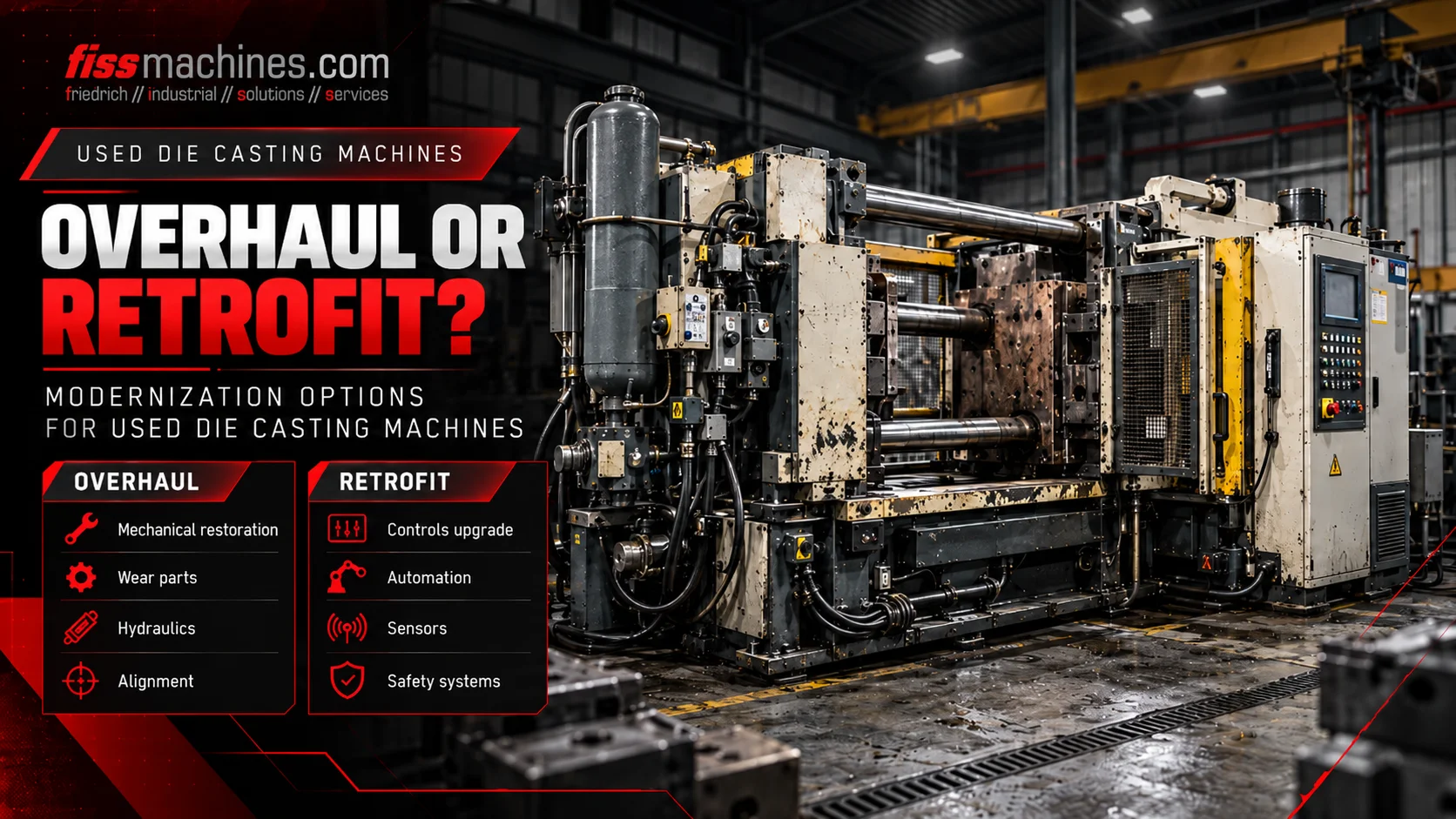
An overhaul restores the machine's mechanical, hydraulic and electrical condition, largely within its original design: seals, cylinders, pumps, valves, guides and wear parts are inspected, repaired or replaced. A retrofit changes the design, typically by replacing the control, drives, sensors or shot control with current technology.
Both have to be followed by a safety review. Whether a modified machine meets the requirements at its place of use is not automatic; it depends on the scope of the changes and has to be assessed and documented.
What an Overhaul Covers
An overhaul starts with a structured inspection and ends with a function test. In between, the scope can range from replacing a few seals to dismantling the machine completely. Terms such as "partial overhaul" and "full overhaul" are not standardised, so the actual list of work matters more than the label.
Typical scope on a die casting machine
- Hydraulic cylinders resealed, rods and bores checked
- Pumps, valves and filters inspected or replaced, oil changed
- Accumulators inspected according to applicable rules
- Platen parallelism, tie bars and guides measured
- Toggle bushings and pins checked on toggle machines
- Shot cylinder, shot sleeve mounting and coupling inspected
- Cooling, lubrication and electrical wiring checked
An overhaul is the right approach when the structure is sound and the existing control still works reliably and can be supported with spare parts. It preserves the machine's known behaviour and documentation.
When a Retrofit Makes Sense
Controls age faster than steel. A machine may be mechanically fit, but its control can no longer be repaired economically, or it cannot provide the data and interfaces a modern cell expects. A retrofit then replaces selected systems with current components.
New PLC and operator panel with current software and documentation.
Valves, sensors and recording for a more repeatable shot and usable shot curves.
Pump drives or motor control updated where the hydraulic design allows it.
Signals for robots, sprayers, presses and data collection.
Retrofits are projects, not repairs. They need a specification, software engineering, commissioning and new documentation, and they change how operators and maintenance staff work with the machine. How peripheral units connect in a cell is described in our article on automation in the die casting cell.
Safety Revalidation: Not Automatic
Every overhaul and especially every retrofit touches safety-related functions: guards, interlocks, emergency stop, two-hand controls, and the behaviour of hydraulics when energy is removed. After the work, these functions have to be checked and the result documented.
Beyond testing, the scope of a modification can have legal consequences. In the European Union, a modification that was not foreseen by the original manufacturer and that affects safety, by creating a new hazard or increasing an existing risk, may be considered substantial. Whoever carries it out can then take on manufacturer obligations, including risk assessment and conformity documentation. The EU Machinery Regulation (EU) 2023/1230, which applies from January 2027, explicitly addresses such substantial modifications. Whether a specific project is affected has to be assessed case by case; operator obligations under national workplace safety rules apply in any case.
Neither an overhaul nor a retrofit makes a machine compliant by itself. Plan the safety review as part of the project from the start, with qualified people and clear responsibilities between supplier and operator.
Overhaul, Retrofit and Safety Review Compared
| Aspekt | Przegląd mechaniczny | Renowacja sterowania | Przegląd bezpieczeństwa |
|---|---|---|---|
| Cel | Przywrócenie stanu i niezawodności | Wymiana przestarzałych systemów, dodanie funkcji | Potwierdzenie bezpiecznej pracy i jej udokumentowanie |
| Zmiana w projekcie | Głównie brak | Tak, w zmodyfikowanych systemach | Być może, jeśli wymagane są środki |
| Główne ryzyka | Ukryte uszkodzenia wykryte podczas demontażu | Zakres, oprogramowanie, czas uruchomienia | Opóźnione wykrycie brakujących środków |
| Dokumentacja | Raporty z inspekcji i prac | Nowe schematy obwodów, oprogramowanie, podręczniki | Ocena ryzyka, zapisy testów |
| Typowy bodziec | Zużycie, wycieki, niestabilny proces | Braki części zamiennych, potrzeby danych | Każda modyfikacja, relokacja, nowa lokalizacja |
Jak podjąć decyzję: Pięć pytań
Czy struktura jest solidna?
Pęknięcia w płytach lub ramie, mocno zużyte prowadnice lub uszkodzone belki mogą uczynić dalsze inwestycje nieuzasadnionymi.
Czy sterowanie nadal można utrzymać?
Sprawdź dostępność części zamiennych, kopii zapasowych oprogramowania i osób, które mogą je utrzymywać.
C what does process require?
Części o wysokich wymaganiach jakości mogą potrzebować lepszej kontroli strzału lub rejestrowania danych niż oferuje oryginalna maszyna.
Co wymaga przegląd bezpieczeństwa?
Wczesne określenie, które środki są potrzebne w miejscu użytkowania i kto za nie odpowiada.
Jak porównać koszty i przestoje?
Porównać cały projekt, łącznie z uruchomieniem i szkoleniem, z alternatywami takimi jak inna używana maszyna.
Inspekcja maszyny przed zakupem to odrębny krok. Powyższe pytania dotyczą tego, co się dzieje, gdy maszyna jest na miejscu lub już w produkcji, i czego naprawdę potrzebuje.
Najczęściej zadawane pytania
Czy maszyna po remoncie działa jak nowa?
Nie zawsze. Remont przywraca stan określony w jego zakresie. Ograniczenia projektowe, funkcje sterowania i cechy oryginalnej maszyny pozostają takie, jakie były, chyba że zostaną również zmienione.
Czy remont i modernizacja mogą być łączone?
Tak, i to powszechne. Ich łączenie unika demontażu dwukrotnie, ale zakres i przegląd bezpieczeństwa powinny być zaplanowane razem.
Czy modernizacja zawsze lepsza niż utrzymanie starego sterowania?
Nie. Działające, dobrze udokumentowane sterowanie z dostępnymi częściami zamiennymi może być tańsze. Modernizacja ma sens tam, gdzie starzenie, potrzeby procesu lub integracja tego wymagają.
Czy przeniesiona maszyna wymaga nowego przeglądu bezpieczeństwa?
Wskazany jest przegląd na nowej lokalizacji w każdym przypadku, ponieważ otoczenie, podłączone urządzenia i obowiązujące przepisy mogą się różnić.
FISS wspiera projekty remontowe i wybór maszyn.
Skontaktuj się z FISS w sprawie kondycji maszyny i zakresu, który rozważasz, lub w sprawie używanych maszyn, które mogłyby zostać poddane remontowi, aby spełnić Twoje wymagania.
